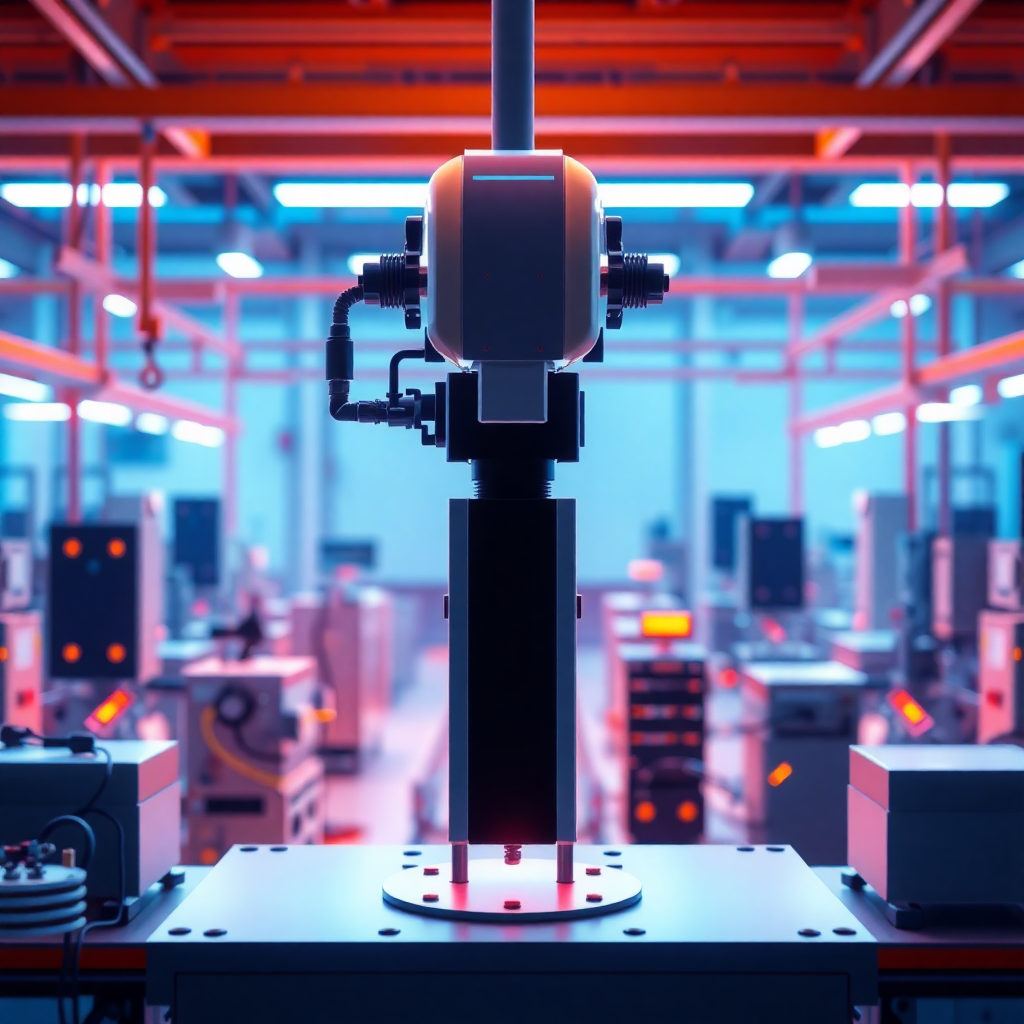
AI Vision + AI Robot convergence · Perceive → Decide → Act
AI-driven seeing and judging is now unmanned, but action is still taught by people. Now, given only the goal, the robot decides where and how to work — and executes.
Vision alone only sees; robots alone have no eyes. Manufacturing innovation is complete only when perception and action are connected.
Even when AI perceives the situation, the action after the decision still depends on people and robot teaching.
Moving only by taught rules — every product or process change means a person has to teach it all over again.
Perceive → Decide → Act → Automatic feedback. Shifting from Human-in-the-loop to Machine-in-the-loop.
On the lines of Hyundai·Kia tier-1 suppliers, a single 3D scan lets the robot position itself while AI computes corrections — and it fastens on its own. No human teaching.
The automation environment is already fixed, and the product information (design) is already known. Given only the goal, AI decides where and how to work on its own.
Evolving from today's integrated system (V1.5) to teaching-less operation that decides its own methods (V2.0).
The core technology axis for moving from perception to autonomous action.
Rapidly transfers capabilities learned in one process to new products and processes. (Domain Adaptation)
Robots learn refined motions on their own by imitating skilled workers.
Work result data cycles back into MLOps automatically, continuously improving the next operation.
Having operated AI Vision on the factory floor for 10 years and built MLOps ourselves, we can finally connect judgment and action.
Frequently asked questions about Physical AI.
We'll show you how Physical AI can be applied to your process, with real-world case studies.